Showing posts with label family. Show all posts

Sunday, 17 May 2026

My worst-ever case of absent-mindedness!


The “soup” at right resulted from me adding a cupful of milk aiming to thicken my Irish stew without thinking!

Today, after a terrible, erratic sleep following a long trip out to Milleara Mall — where I found some very good value fruit with which I helped make a quince pie (the first made in the house all year) — I agreed with my mother to make an Irish stew. It was fitting given the shift from a long run of warm and sunny days to rain this morning.

 Last night — a very warm morning which hardly got below the temperature of a comfortable afternoon — was terrible for my sleep. This was not wholly my fault. I was repeatedly waking up to hydrate myself after the strenuous travels of yesterday had produced a bad headache. At the same time, my mother and brother have both been suffering a really bad cough, and the noise from that cough helped prevent me from settling down to sleep. The warmth meant that I was unable to get the correct temperature for sleep: it was too warm with the blanket and too cool without it, while I was not bothered to take it off and sleep with just the sheet as I normally would during very warm summer weather.

During the afternoon when I cooked the quinces and the Irish stew, this did not seem to be a problem. However, with a break in the weather around 4 P.M., I went out for a walk around to the Royal Melbourne hospital, and then was asked to thicken the Irish stew. This is when things went really awry. I rushed to get the stew thickened. However, I did not think about how to do it, thinking all I had to do was to make an unmeasured mix of milk and flour! Having recently only made chicken stews thickened via noodles, I could only think to thicken via mixing milk with flour. I did this immediately without asking for any help, but I put so much milk that when I showed my mother what I had done, I was chastised severely. I immediately showed the coffee mug (not in the photograph above) and when inquired as to why the stew was so runny, said that I had put into the stew one whole cup of milk! My mother was seriously upset, and both my mother and brother said that I should not thicken Irish stews because I do not know how to do it. I became  angry, saying that at the very least I could learn how to thicken properly.

Although I hoped that I could evaporate the milk, I know that would never be allowed! Hence I accepted removing some of the fluid as a soup — not bad to eat as I know from past experience. I was soon told that when thickening stews with flour and milk:

  1. I must aim for a thickness comparable to honey or even slightly thicker than honey
  2. I must add the milk to the flour and never add the flour to the milk.

The real problem for me is remembering this when I next make an Irish stew or some other type!

I any case, despite me being really upset, the stew and the quince tart did provide a nice dinner. My real hope is that I can learn how to thicken stews again!

Sunday, 10 December 2023

The problem of “don’t ask” just from fearing no

This evening I went into a terrible temper tantrum when my mother complained that I left cooking rissoles for tonight’s dinner until they were seriously overcooked and smelling.

The tantrum, with familiar phrases (mantras) like:

“get the word “can” out of your head”

“there’s no such word as “can””

and less familiar mantras like

“I used to be able to [remember to come down] but I can’t now”

and gestures like trying to place the word “can” in the rubbish bin in the kitchen [by pointing to the rubbish bin in a terribly agitated manner], became so bad that I even walked out of the house without my mobile phone! Outside I was just as angry and agitated — trying basically to make my mother recognise that I was totally incapable of reminding myself that I had cooking to remember when I was sitting at the very computer where I am writing this post.

My mother was just as upset as I was — and I might note that she has not been well in recent weeks, having mucus-y coughs for the past week or more. It has been difficult for me to appreciate her troubles, but I hope I becoming less bad at it.

After I came back — deliberately knocking softly in order to, as it were, persuade my mother that I had calmed down — I did speak much more calmly about the issue. I enjoy cooking, but my mother had said that I might have to give it up if I forget it time and time again as I have been doing for the past few weeks.

When I look at it logically, I recognise how I was obsessed with watching football and possessed zero desire to do the cooking. I simply wished to watch the football and listen to music as I had been doing for many hours before I went out to walk the dog, but feared my mother’s opinion too much to say “no”. So, I did the cooking as quickly as possible and was quite lucky in fact not to burn the spring onion, celery and mushroom mix that was to be mixed with the mince to make the rissoles. Although I said to Mummy that I would come back when I put the rissoles in the oven, I immediately and totally forgot as soon as I was back settled at the computer watching football. There was not the slightest thought about what was happening inside the oven until the DVD was finished. So unconcerned was I that I was actually surprised that the rissoles had nearly burned over!

Once I came back, realising that I could not keep screaming and screaming outside, and even feeling my vocal cords somewhat weakened, I tried to talk to my mother about what needs to be done to give some hope this will not happen as consistently as it has been of late. I am probably reasonably convinced that there is no hope I can be instructed to remember to come down when I am totally focused on listening to music or on watching football (of course, anything I am watching on the computer would have the same effect as football!). Both of us were extremely upset at the way I expected my mother to be a “lackey” upon whom we can fall back whenever I forget cooking jobs that I do just to please her when my actual desire is to listen to music or watch something on the computer. I actually say I want to cook to appease my mother when I actually want to spend all day doing exactly what I want — which, today, was to watch football.

However, the most notable lesson from tonight’s tempera tantrum was that my consistent refusal to ask my mother whether she would either:
  1. remind me by coming up to the study or
  2. look after my cooking
out of fear of being told “no” is really, really bad. It might be wise because I know all too well that if my mother said “no” I would most likely go straight into a meltdown as bad as today’s. However, my deliberate silence has meant that my mother and I are both left ignoring the cooking with risks of burning. When I look at it, I thought of the many old English cricketers — for example Walter Brearley or George Louden — who would likely have greatly improved England’s prospects in Australia but were never questioned about touring because MCC was sufficiently aware they had zero possibility of being away from business for so long. My case is different because I have never tried — out of partially justifiable fear of being told “no” — to ask my mother to watch over my cooking. Instead, I assume she will do so as my slave. When in a tantrum, of course, I justify it as a “one-way street” where I can do and get exactly what I want one hundred percent of the time, although logically this “one-way street” is totally selfish and makes everybody else totally immaterial. It is clear to me — whether I cam capable of change or not (and I have zero belief I am) — that I must do something to prevent me forgetting my cooking, or develop some sort of compromise where I do the preparation and my mother agrees to watch over the cooking. In a logical mood these compromises are terribly unfair to my mother, but given my lack of genuine interest in cooking it is unclear what else we can do??

Monday, 8 June 2020

“The Incompetent Security Game”

As a child, I read three of the eight Famous Five Adventure Games (see a discussion of another aspect here) – The Sinister Lake Game, The Whispering Island Game and The Secret Airfield Game. I was probably attracted by the numbers of the paragraphs in the games working out the games’ structure, which is quite logical but not explained anywhere on the web as far as I know.

Even back in my childhood, my brother always said the games were contrived – something I will admit without a grudge and which still gives me a bit of humour even in my forties. Since my unsuccessful librarianship course, I have collected the five remaining titles, although I have not been able to get the full cards for The Wreckers’ Tower Game or The Shuddering Mountain Game.

I always could recognise Blyton’s xenophobia in most of these books. Most although not all the villians are Italian (The Whispering Island Game) or Russian. No doubt this xenophobia reflects Blyton’s upper-middle-class hostility to the internationalism of Europe’s socialist working classes, and of course Russian international power and the spread of Stalinism was an especially salient issue in the 1950s.

Often, and still today, I have imagined whilst knowing it wrong that the Famous Five is fact rather than children’s fiction written by a middle-class woman undoubtedly hostile to the urban lower classes. However, despite having known the problems of the stories for a long time, today my brother offered a new twist on many jokes we tell about them. He argued that the story of Jeff being abducted by two men was entirely unrealistic because a secret military airfield would be much better guarded than the story in The Secret Airfield Game (and the related story in Five Go to Billycock Hill) implies. He also said that theft of a top secret military jet would have been investigated by military police much more quickly than implied in the stories, where there is no evidence of any investigation other than by the airfield’s ordinary guards. My brother made a really funny joke of calling the game “The Incompetent Security Game”, arguing that a secret military airfield would never be left unguarded even in the dark of night. Even with the limited technology of the 1950s, I agreed and agree enough to see that I had overlooked entirely unlikely elements in the plots of the Famous Five Adventure Games.

The name “The Incompetent Security Game” is really, really funny, unlike my brother’s “Child Labor Game” which implies that the Famous Five did not enjoy what they were doing. Its only problem is that it would imply that the mystery is to be solved in government negligence, which Blyton would not have wanted to convey. In fact, she likely wanted to convey the idea that ordinary people should take responsibility for crises as deep and as specialised as theft of critical military equipment or of minerals or old treasures.

Tuesday, 12 June 2018

A severe indictment of Melburnians’ knowledge

Over the past two days, searching for a bookshelf for my brother’s new home and even for my mother’s birthday, I have undergone some quite substantial travels around Melbourne – to Ringwood, Watsonia, and Williamstown.

In comparison to the “galloping round the countryside” of twenty years ago, these trips have been rather less undisciplined and I have come home to actually eat dinner with my mother – something exceptionally rare even in the days before the Queen’s Birthday.

“Lack of public transport that can compete with the car leads to heavy car traffic” (Public Transport Users’ Association; ‘Driven around the bend Melbourne’s meandering bus routes’, May 2012)
Even if I have not been randomly “galloping round the countryside”, the desire in me to travel on as many bus routes as possible has never really been lost. With increasing runaway climate change observed everywhere, I have often joked that riding Melbourne’s awful bus services can show where global warming is coming from. Although it is true that all one-occupant car journeys being replaced by public transport would save a lot of energy, with age I have come to realise that almost exclusive focus on roads at the expense of rail is not the cause of Australia’s almost uniquely dreadful record when it comes to greenhouse gas emissions. In fact, cars account for only about one-fifth of Australia’s greenhouse gas emissions, and both coal power and land clearing stand as equal culprits in giving the country the worst emissions record in the world, especially considering its uniquely low-energy ecology amongst extant continents.

What really struck me hard about these trips to inspect bookcases was that none of the sellers knew even the local bus routes whose stops they must have seen when driving! This ignorance is rendered easier by the extremely low frequencies (never more than every forty minutes) of many if not most buses in Melbourne, so that casual drivers may never see a bus when not looking. This gives the illusion that there is no public transport whatsoever away from rail lines and the old inner suburbs.

In fact, public transport more often than not does exist, but is of such abysmal quality that nobody with a car would dream of using it even if concerned about the effect of cars on out climate. Nonetheless, having to use such extremely bad public transport is something people from countries where road lobbies are less politically dominant needs to experience. It will show them how vested interests can ruin the environment and create traffic congestion, and how fortunate most of the Enriched World is regarding its public transport, and how I have had to sacrifice proposed library trips today to do shopping to pay for my brother’s new bookcase because of the slow and very infrequent public transport in Melbourne.

Tuesday, 31 October 2017

Forty years of my life

Photos collected by my mother of myself over my first forty years. Most are from my childhood when I was much slimmer and more red-headed
Today, as promised by my mother, there was a special fortieth birthday party for me – complete with a rebound original 1890 Wisden as a special present. Normally I could not be given so expensive a present as this $500 Wisden, but my mother agreed to for this occasion since she says forty years is the midpoint of my life.
The 1890 Wisden bought for my birthday. A pity that the image is blurred!
The 1890 Wisden is not only the oldest original Wisden I have ever received, but makes continuous my collection of peacetime Wisdens from 1881 to 1992. The 1889 season covered by it is notable for the debut of “the rhyme that lies”, a reference to Arthur Mold and the phrase “Mold bowled”, repetitive in the thirteen Wisdens from 1890 to 1902. Mold debuted to devastating effect in 1889 on a series of fiery or crumbled pitches, but he was considered by most neutral observers to be extremely lucky to bowl twelve seasons before being no-balled for throwing. Mold took over fifteen hundred first-class wickets and his speed and off-break made him unplayable when pitches crumbled or were sticky. It’s probable that the exceptional strength of English bowling in the middle 1890s – a strength rivalled only in the middle 1950s since – and his weakness with the bat helped Mold to get away with an unfair delivery for so long.
The original 1904 Wisden I bought myself. It contains the full book inside – I couldn’t show the pictures as the fingers are not mine!
Aside from the 1890 Wisden, I also received an original 1904 Wisden of exceptional quality and price. I did have a Willows 1904 Wisden, but receiving so good an original at such a price (it was discounted because of numerous blank pages at the rear which I find ridiculous).

The birthday was highlighted by a remarkable abundance of good food, as my brother came from Monash for both lunch and dinner. The lunch was a familiar supermarket roast chicken with stuffing, but I ate it up enough that I did not realise there was a little more chicken in the bag. There was a remarkable amount of cake – one older mandarin and almond cake, one lime cake and one pear and chocolate moose cake which was bought for the birthday of myself and my brother. All three cakes were delicious, the mandarin and almond cake made to test a new cake tin especially so.

We walked to the city after this, and I was bought a pair of very good sunglasses, after being laughed at for the sunglasses I had suggested earlier. Although I squint very badly in glary sunshine, I possess no experience buying sunglasses, but the pair I was given is certainly very good and fits me better than the pairs I was criticised for trying. I was by then quite tired, and after we went to Chemist Warehouse, we travelled home by tram.

The last part of the birthday was another highlight. We went to a small French restaurant in Rathdowne Street that – despite walking or cycling down the street countless times since moving to our present address nineteen years ago – I had never so much as seen! We were the only people in the restaurant, and although the food was very expensive the duck and orange sauce I had were utterly delicious! I have seldom eaten such tender and sweet food in my forty years!

During our time in the restaurant it was commented that I became nervous when others spoke consistently about topics not of interest to me – something highly perceptive because I know instinctively that it is very hard for me to listen to conversations on such topics! This was true even with subjects like the death of non-Mandarin Chinese dialects, or modern cricket, where I would have some hope of speaking with some knowledge. The restauranteur had had an unusual history, having lived in Singapore and England before moving to Melbourne.

The last stage of the trip before my brother left to go home was a gelati at a place in Lygon Street opposite the main shopping centre where I have done most grocery shopping for many years. I forget the name but enjoyed the mango and strawberry gelati very much.

All in all, this was a great fortieth birthday and I appreciate why we cannot have this every year. I also appreciate the problems I have had with my behaviour, which still do not go away despite my mother saying I am always improving.

Saturday, 10 September 2016

Further again from real Messiaen!

As regular readers will know, my mother and brother love to satirise Olivier Messiaen’s amazing piano works like Catalog d‘Oiseaux, Visions de l‘Amen and Vingt Regards sur l‘Enfant Jésus. The amazing skill playing real Messiaen takes is entirely disregarded, and their inability to understand the extremely complex rhythms and melodies of the music means they resort to crude criticism of calling it equivalent to “a cat playing the piano”, although it is true that several others listeners have said exactly the same thing about Messiaen.

Recently, however, my brother has gone even further with his Messiaen satirisation, saying that a dog playing the piano is the best new Messiaen recording!
In fact, although dogs are more intelligent than cats, there is no way they could play something so difficult even for a highly trained pianist as Catalog d‘Oiseaux with any sort of training. Nor could that dog know what “Messiaen” actually means! More than that, if a cat’s playing the piano sounds – when listened to carefully – in no way like a real performance of any Messiaen piano piece, and is much more clearly different from such even than a cat playing the piano. (Of course, I must emphatically emphasise that a cat playing the piano has no sonic resemblance whatsoever to actual Messiaen piano works).

When my brother said it was a new Messiaen work, I laughed loud. The best wish for all who cannot understand Messiaen is not to satirise but to try, even if they (as my mother and brother do) detest the objectives of the cultural milieu of which Messiaen’s work is part (partly because I talk about a much more gory and unsavory part thereof).

Sunday, 24 April 2016

Delegitimisation of low-skill work in the Enriched World

Although it is now extremely well documented, for instance by The Washington Post’s Sarah Puliam Bailey, that the US – for some time the last bastion of Christianity in an atheistic Enriched World – is going more secular by the year, George Friedman has had a look at how seismic the shift has become, putting genuine traditionalists in a position as difficult as they were under Stalinist regimes in Europe during the last century.

In Europe, the true traditionalists, even in de jure Catholic countries, have found life impossible for a very long time – to illustrate, the last Amish communities left Europe in 1937 – due to the high price of land and powerful unions jacking labour and living costs to a level where only the highly educated and skilled have hopes of living with socially-expected comforts, as Friedman notes:
“The fourth quintile, the heart of lower-middle class, earns about [US]$31,000 a year before taxes per household. I grew up in a lower-middle class household (my father was a printer, my mother a homemaker, and there were two children). We owned a house and a car and took a vacation. Today, people in the lower-middle class are bringing home, at best, [US]$2,000 a month, and they will not own a house but instead pay [US]$1,200 a month to rent an apartment, with the rest going to food and other basics. The lower-middle class can no longer afford what used to be a lower-middle class life.”
Being dependent on consistent change to maintain employment – high technology by its nature is always advancing – and isolated from family relationships, these highly skilled and educated technical workers tend to be (alongside welfare recipients) the most secular group of all. The history of Europe since its workers’ political demands created the welfare state shows how these two groups will squeeze the remainder of society out, leaving productivity centred on sectors necessarily “impermanent”. “Impemanence” (for want of a better word) is simply incompatible with opportunities for those of lesser skill, who must move to the American South or suburban Australia to possess socially-desired levels of comfort rather than cramped housing at high prices or rents. At the same time, these lesser-skilled workers either accept big government – which as noted above dooms them since requisite high taxes prevent them keeping adequate revenue to obtain the expected gadgets and comforts – or face ridicule from the welfare classes and academia, as Friedman discusses below regarding American workers:
“The white lower-middle class is divided into two parts. One part has already been shattered by economic pressures, family fragmentation, drugs, and other forces. Another part is under equal economic pressure but has not yet fragmented. It retains values such as religiosity, traditional sexual mores, intense work ethic, and so on.

“This is the class that has been deemed pathological by the media and the upper classes. Its opposition to homosexuality, gay marriage, abortion, promiscuity, and the rest (which was the social norm a generation ago) is now treated as a problem that needs to be overcome, rather than the core of a decent society. The speed of the shift in the values of dominant classes has left this class in a position where those values taught at home and at church are now regarded by the broader society as despicable. Repercussions are bound to happen.

“The simultaneous economic disaster and delegitimation of their values marginalized this class. When Mitt Romney referred to the 47% who were parasites in our society, he was referring to these people. When Barack Obama was elected, this group felt that the focus had shifted to the black community and saw itself as invisible (and to the extent seen, contemptible). Economic, social, and cultural evolutions had bypassed them.

“Their perception of the political system has become intensely cynical. They see the political elite, bankers, lawyers, and lobbyists as a near criminal and entirely incompetent class. We speak of unemployment after the 2008 recession in terms of numbers. These are the people who were unemployed. They view this elite as claiming rights they haven’t earned. The lower-middle class can tolerate earned wealth, and even respect it, but cannot accept what they see as manipulated wealth and power.”
What these people believe Trump aims to do is to eliminate the extreme inequality of opportunity of highly skilled vis-à-vis unskilled workers within today’s United States. Thus runs very much counter to prevailing trends: absence of low-skill opportunity, is, of course, much worse in Europe and East Asia than the United States, and its consequences run deep at levels whose discussion is off-topic here.

“Delegitimation” (no doubt a US colloquialism) of less-skilled workers by both the highly-skilled technology sector and permanent public welfare recipients (what Friedman would call the lowest quintile) is a last stage in the Enriched World’s economic and cultural transformation that for some like Sam Harris or Gregory Paul (as here) represents an ideal, but which ought also to be considered from the observation that more migrants move to the religious American South – or as expatriates even to the anti-democratic ultra-Muslim Gulf monarchies of Saudi Arabia, Kuwait and Qaṭar – than atheistic Sweden. They do this for the simple reason that those without advanced education can hope for nothing more than welfare in Sweden but have strong job opportunities in the American South and can gain better wages in the Gulf States than in resource-poor tropical Asia. Paul fails to consider how countries with “inferior” conditions can and do attract migrants though lower taxes, lower living costs, and fewer regulations that allow anyone – not just those with training extending to beyond a person’s prime reproductive years – an acceptable standard of living.

That this be a valuable “counterculture” for Enriched nations to consider I have no doubt – it was opportunity that grew them into powerhouses, and lack of opportunity that has already caused irreversible decline in large areas of these nations and will no doubt shift power further in the future.

Saturday, 16 January 2016

Lessen for buying Pink Lady apples

Two Pink Lady apples bought at Woolworths mid-week. Notice how they are completely infected with a brown fungus, species not known to me or my family
Mummy and I have liked the fresh, crunchy flavour of Pink Lady apples for over a decade now, so much so that apart from occasional purchases by myself of Granny Smiths we rarely buy any other type.

This week, as we prepare for a lengthy holiday in Singapore, Japan, and with a not-yet-acquired visa Vietnam, I had a rude shock when I brought a few Pink Ladies to tide ourselves over in our last few days in Australia. I bought four Pink Ladies, and found the first to be so brown – infected with a fungus of a species I have not researched personally – that I dared not eat it. When I was in the local Woolworths buying the apples, they felt quite OK, and in the past buying fruit I have always tended to rely on feel since bad fruit is more often than not bad only inside.

However, when we discovered another completely infected and inedible apple on this last day in Australia, and when I first noticed the earlier bad one, my mother said that bad Pink Ladies can in fact be detected by means of their yellow colour in the core skin. One can faintly see a yellow colour in the core of the opened apple, and the one uninfected Pink Lady was green or red all over.

This really should be a lesson for all shoppers, as well as for Woolworths itself!

Thursday, 19 November 2015

‘Time’ has knowledge I knew from two decades ago

During my time living at Keilor Downs between 1989 and 1996, perhaps the most memorable incident was when I went to Keilor Downs Plaza to look at the video shop (I was then obsessed with movie ratings and the possibility that violence was due to young children watching violent or rude films – a view I have by no means entirely discarded) and tied as I usually did our pet border collie, Minty, outside the shop.

After a brief stay in the shop – a shop I have no recollection of ever visiting again – I found that Minty had forced the leash loose and had run off. I thought with considerable sense that Minty would go back to our house in Daimler Avenue. When I went back there, my family, including my late uncle and father, said Minty had gone up to the north along Rodney Drive and Belmont Avenue where there were two places I frequently visited. One was a small milk bar, where I often looked at the movie ratings of the VHS tapes in the store as I bought milk. The other was a large reserve at the northern end of Belmont Avenue, where I occasionally played on the swing (and was even then seen as too old for that though I had not put on the vast amount of mass I have now). When I found the playground, Minty had gone and I was very worried.

My assumption was that if Minty had left the park where my family said he had gone, then Minty would have kept walking in the same direction since at the time he had not returned. Thus I kept walking, following my instinct on this line (and my recollections from over two decades ago) up Belmont Avenue and then Copernicus Way, Chichester Drive and up to what was then known to me as Keilor-Melton Road. There was no sign of Minty at the time, and having neither a mobile telephone nor coins for a public phone, I was really worried but I still kept walking, expecting Minty would be somewhere around Calder Park Thunderdome. I never found the dog, and I could not imagine how worried my parents would have been (I had no money and it was the pre-mobile era), but I knew only to keep going and going in hope. By the time I was at Keilor-Melton Road, I did not know whether to walk further north or just keep looking, but there was never a sign of Minty. Eventually, I was so tired I felt I had to walk back home, and I found, to my shock, that Minty had come back soon after I went off looking for him! My mother said he was not a “north-heading dog” as I had naïvely assumed from when she said Minty went after escaping the leash.

Within my family, this story has long been a legend, but the amazing thing is that Time in ‘The Amazing Science Behind Pets That Find Their Way Home’ has shown that the knowledge discovered from this old family incident is widespread. Mummy said to me when I came home very tired that Minty actually knew his way home, and Time’s tale of a dog walking much further than from the park on Belmont Avenue certainly verifies what my mother said to me more than twenty years ago! According to Bonnie Beaver’s research which was quoted in Time, dogs create overlapping scents – which in the case of Minty would no doubt have been acquired while my brother and I walked him to and from the park for a few years before he escaped the leash. No doubt, when Minty escaped the leash he knew where the familiar scent of home was, and went back to that and then to the park on Belmont Avenue.

Wednesday, 18 November 2015

“Bloodworthgrad”, “Lee Ackgrad”: not new ideas

A decade and a half ago, when I became obsessed with Socialist Alternative, Socialist Worker, Militant and Resistance – in the process imagining their membership as comprising a majority of Victoria’s student body rather than merely a tiny number of activists who put posters up everywhere – my brother said consistently that if these Trotskyists came to power they would do the same things that were done in what I then called (and still do as a joke) the ‘Empire of State Capitalist Dictatorship’ (ESCD), ‘State Capitalist Dictatorship of China’ (SCDC), ‘State Capitalist Dictatorship of Korea’ (SCDK) and ‘State Capitalist Satellite of Germany’ (SCSG; German ‘Staatskapitalistischer Satellit Deutschlands’ or ‘S.K.S.D.’). In particular, my brother once spoke of the “Democratic People’s Republic of Australia” and that all Australia’s major cities would be renamed as they were in the Russian empire after the leaders of the revolution like “Bloodworthgrad”, “Lee Ackgrad”, “Bloodworthsk” and so on. (He admitted though that such names would be tongue-twisting to pronounce).

The Trotskyist groups themselves deny this would happen and that with workers controlling the system through workers’ councils under genuine socialism this would not happen unless it was voted for. They believe that all Russia’s place name changes came after Stalin began his counterrevolution and are not a part of true socialism with workers owning the means of production. With age, I have become very sceptical of claims that the violent class struggle and workers’ militia advocated by groups like Socialist Alternative could produce the utopia of equality, abundance and sustainability they claim, but still their ideas are interesting.

A couple of days ago, in a marginally curious mood, I looked in the State Library and found a seemingly interesting book titled Women of the Far Right: the Mothers’ Movement and World War II by one Glen Jeansonne. I retrieved it immediately, although I did not read it until yesterday, but when I had a good look it seemed both interesting and repetitive. Repetitive because it showed these conservative women attacking not only FDR, but also his first Lady Eleanor Roosevelt for being too modern or masculine. Interesting because it showed up many new facts – for instance that Henry Ford was targeted by both the Democrats and Republicans for the 1924 Presidential election!

The most startling thing I have found in a partial read of Jeansonne’s book, however, was quite startling both as a fact and as a memory. It was that when right-wing “Mother’s Movement” activist Elizabeth Dilling went to Russia, she was not only horrified at the shortages of basic goods and the doctrinaire atheism, but also discovered maps where major cities in the US (which were not mentioned in the book) were renamed after Stalinist heroes – exactly like my brother joked would happen if Trotskyists took over in Australia.

It is surprising that no anti-Communist has ever widely publicised this – let alone reveal exactly what names Stalinists would have given major American cities had they become able to execute their plan. If they could have done this, it would be interesting to imagine the response of affected Americans. Would they have been much more appalled than my brother – who took the story as a joke although he still held dogmatically to the idea that a revolution in an advanced or especially in a resource-super-rich nation would have the same result as in more primitive Russia, China, Yugoslavia and Cuba.

Another fact untold by historians found in Women of the Far Right is that opposition to the Vietnam War through wanting the Vietcong to win had a precedent. Numerous anti-Communist and/or anti-Semitic parties during the 1930s and before Pearl Harbor opposed World War II because they wanted the Nazis to win – a story which neither the PIGs nor standard textbooks nor the Trotskyists tells today’s children. Most of the people in Jeansomme’s book fall into this category, and for this reason the book gives a lot of insight as to why the US, Canada and New Zealand did so little to accept Jewish refugees from Europe – only the marginal Trotskyists wanted to remove all restrictions on Jewish immigration and thus prevent the Holocaust, and FDR turned back many Jews to their death (Canada and New Zealand were vastly worse still).

These days, findings so unexpected as the story of Elizabeth Dilling are rare enough to be more shocking than when I first read Socialist Alternative and seemingly discovered that what I was taught about socialism and capitalism in schools was wrong, or the reverse finding from reading Hans Hoppe or Murray Rothbard.

Saturday, 31 October 2015

Silly jokes about Jennifer Bate – again

On my thirty-eighth birthday – and feeling how much time I have simply wasted – my visiting brother and I went into some details about how the Austrian School of economics tries to hide its funding by what he calls the “richey rich” and organisations like Socialist Alternative call more simply the “super-rich”. He says that the Austrian School simply try to hide their interest in the “super-rich” in order to gain wider appeal than they would have otherwise. I have assumed with both Austrians and Trotskyites that ignorance is the reason people do not read them and that, notwithstanding the fact that it is possible that both groups argue too much that the same solution exists for every problem, that they are committed to find genuine solutions as few others are.

After a bit of diversionary talk with my mother, who was very busy cooking our birthday dinner, Jonjo began to move onto one of his favourite – and least appealing to me – criticisms of me. He said that organist Jennifer Bate, whom he had previously ludicrously called a “cat”:
  • had to have “meows” removed from her recordings!
  • had to have “purrs” removed from her recordings!
  • that she loved to drink milk!
  • that she loved Whiskas!
  • in an old joke, the the quieter parts of Messiaen organ works were Bate the cat sleeping on the organ!
  • was the oldest cat ever known in the world
    • At 71 Bate would be almost twice as old as the oldest certified real cat!
  • that Jennifer Bate might already be dead and that a cat might be doing the work credited to her!
As I said in a previous post, there is no way any cat could perform real Messiaen organ works! It would also cost a lot of money to edit purrs from a cat playing the organ (though it is also possible that purrs and meows would not be recorded at all and the cost would be less). The possibility a cat – a terrestrial carnivore which could easily be injured killing prey – could live as long as Jennifer Bate has is incredibly remote. Even the largest and wildest “big cats” of the subfamily Pantherinae never live nearly as long as 71 years in the wild or even in captivity!

It would be wonderful for my brother to accept that recordings of Messiaen are played by real humans, but though I never had trouble liking his music and appreciating its uniqueness many people apparently are different and react in an aggressive manner against it. Maybe, maybe, ignoring is better than trying to be rude??

Thursday, 15 October 2015

A horrible accident on a horrible day

Although I knew that today was going to be very hot – and thus a great day to wash my delicate bamboo summer sheets that require low spin and hence more natural drying – I had a moment of virtual madness a couple of hours ago that I feared would cost me a great deal and left me in the worst of quandries.

It is a familiar practice on uncomfortably hot days to move the clothes horse out to the balcony to aid drying – and necessary with bamboo sheets that must be spun at 400 revs per minute instead of 800 (I am careful about these instructions, although my mother urges me not to be).

This morning, as I was discovering that one sock was missing, I went back from the balcony to get the other sock which I assumed (correctly) remained in the washing machine. However, to my dreadful shock, I found that I could not get out of the balcony as I had locked the door from the inside by tuning the latch! The first inclination I had was to try to climb down from the balcony to the courtyard below and get back inside from there. However, with my fat stomach and bare feet I knew three things:
  1. it would be tough to climb down the narrow holes
  2. I would risk breaking the ledges if I tried
  3. I would risk an ankle injury from landing on the hard bricks
Consequently, I shouted “HELP, HELP, HELP” southward towards Coleman Place, whose houses (though not the actual lane) can be seen directly from the balcony. At first there was no response and I – imaging extreme ascetics I have been reading about like the eighteenth-century Ephrata Cloister who slept on hard wood – I tried to fall asleep in the hope I would be able to get enough sleep even in the hot weather to forget that I was locked out in a hot balcony.
This is the bed of a Brother or Sister (celibate) in the eighteenth-century Ephrata Cloister. I imagine it easier to sleep on than the outdoors balcony I tried to sleep the day on waiting for my mother.
For a little while I did sleep, but the hot air and wind eventually woke me up and I resumed calling “HELP, HELP” towards Coleman Place. Eventually, a man by the name of Chris (at first when I heard I though his name to be “Cress”) caught my call and I told him – without even seeing – that I was locked out on my balcony. After an error, I managed to get my mother’s mobile number, but although Chris did manage to call it my mother was busy teaching. I thus asked Chris to message my mother with an urgent notice that I was locked out on the balcony, and to get the police in case there was no way she could come home. I also gave my half-sister’s number (the only other one I could remember) but there was no answer either. So, I was desperate and unable to rest as Chris left, saying that he was going around to try to get the police in by the front door, which I was not sure practicable because they might not have had the appropriate tool to get locked-in people back in like locksmiths do.

I remained fidgety all along until I saw Chris’ neighbour, Lorraine, and a Chilean woman called “Coca” (full name “Catherina”). I told them what had happened and Lorraine said that being locked out was not a unique problem for me. When it was inquired how the police – who were slow to the point of some worry – would get in, I suggested that they climb the wall at the back of our house and Lorraine tried herself with a ladder she had – hoping in fact that the builders (rebuilding the Carlton Baths) would offer the police one for the emergency! It was thought that a big person could do it easily – and indeed when the police came they had no trouble at all and soon unlocked me, the weather already horribly hot!

I feel from this that I was dreadfully careless – and was in a daydream when I went out to the balcony! What lessons can be learnt from this unfortunate accident I do not know – since in many circumstances I would not have been able to call for help as I did.

Saturday, 18 July 2015

The fallacy of forgetting climate history – and of believing averages

During the winter of 2013/2014, after I had told my brother Oklahoma would have “pleasant weather in March, April, October and November”, said that “October was by far the most pleasant month” he had experienced in Norman, and that November was very cold due to the wind.

Today, well over a year later with my brother permanently back in Melbourne and working at Monash, I had a look at the weather in Norman during the period from November 2013 to January 2014 (figures courtesy of the US National Weather Service:
Daily temperature range for Norman, Oklahoma between November 2013 and January 2014
What one can see is that, for the most part, the winter was colder than average. However, no day was nearly as cold as some previous historic cold months in Oklahoma like February 1899, February 1905, January 1930, January 1940, February 1978, January 1979 or December 1983. In these months temperatures reached below 0˚F (-17.8˚C) occurred across the state, with very high wind chills. No doubt those would be dreadful to experience even compared with my 2009/2010 holiday in Japan, Helsinki and the Northeast.
Temperatures (˚C) for January (dark blue), winter (royal blue) and November to March (light blue) in Oklahoma City between 1890/1891 and 1996/1997
Although I cannot gain any ideal of wind chill temperatures, it is nonetheless clear than the winter of 2013/2014 was not unusually cold and that it may be my fault for not realising the effects of wind chill in what I said to my brother about the climate. I then asked my brother about several December days shown in the top diagram which went from -0.6˚C (31˚F) to 20.6˚C (69˚F). Although my brother was travelling around Texas and New Mexico during the period from 17 to 20 December 2013, he said days going from 0˚C to 20˚C were “basically cold”, although to me 20.6˚C is shorts weather unless it is windy. However, I rebutted my brother by saying that Oklahoma city’s hot spell in February 1930 – following a severe cold wave in January – “was not jumper weather”, which can be seen from the graph below:
Oklahoma City temperatures during the winter of 1929/1930. Note the extremely cold weather from 6 January to 2 February and the very warm spell from 5 to 24 February.
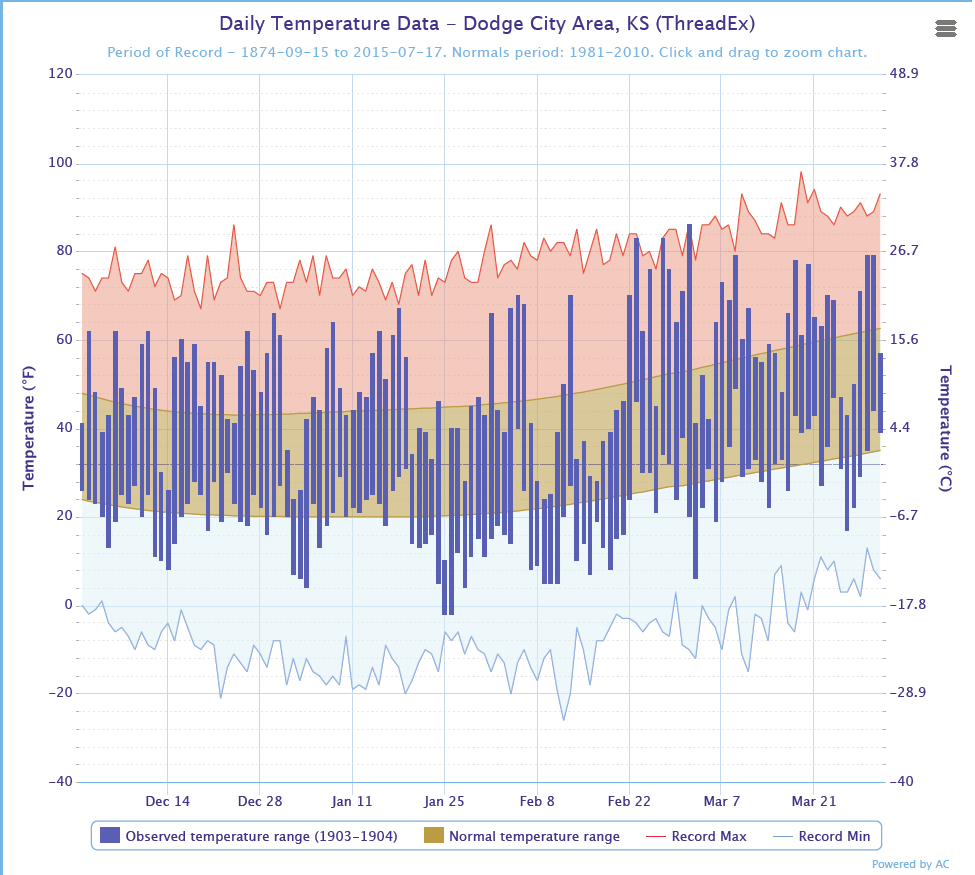
The fact that temperatures in the Great Plains during winter can change dramatically has long been known to me: Havre, Montana in the north of this region has ranged in February from an arctic -49˚C to a warm-enough-for-shorts 24˚C, which must be close to a world record for the largest range of recorded temperatures at a single station during so narrow a range of calendar dates. In February 1962, Scottsbluff, Nebraska ranged from 25˚C to minus 33˚C. In fact, temperatures under the influence of Föhn or “chinook” winds in the region can range within one day by up to 56˚F or 30˚C, as was observed in March 1904 in Dodge City, Kansas:
Daily temperatures from December 1903 to March 1904 in Dodge City, Kansas. Note the extreme diurnal temperature ranges in late February and early March – on one day Dodge City went from 86˚F to 20˚F, both hotter and colder than was reached here in Melbourne in all of March 1904.
These figures taught me something I knew – that people should not ignore past weather as, notably in Western Australia and the Northern Territory, it can owing to the absence of Australian greenhouse emissions be vastly different from present weather. it also taught me something I did not know – that averages and even extremes can be misleading as to how comfortable the weather is. Wet-bulb temperatures in hot, humid climates are a well-known case, but wind-chill and sunshine in cold climates can be a major problem. This is especially true in nations like the US that provide few data on actual wind-speed (though many on wind-chill temperature) and on sunshine.

Monday, 29 June 2015

A look at my garden

Although I seldom do this, my mother has long been noticing her orchid in flower in this mild and dry weather, and this morning she decided to photo it and I – affected by shoddy iron-on patches and the prospect of ruining a pair of jeans that actually fits my fatter-than-ever body – accepted the photo although my heart was in nothing but getting a properly sticking pair of iron-on patches or sending the jeans to a tailor. I have a glimmer of hope about this issue but fear ruining a good pair of clothes!
The orchid is striking when looked at – and the beauty of the flowers actually matches some of the textbooks on the topic I recall reading years ago. The picture still reveals the problems the house has had with its back and side walls – it is not something with a rustic appeal like so many older goods handmade from quality materials.

Sunday, 11 January 2015

The historic Tasman Peninsula

Today, after a sleepless night with the news my uncle had succumbed to cancer in the morning, Mummy, my brother and I, very sad about it, nonetheless decided to go to the Tasman Peninsula. This peninsula, with the typical hilly, green terrain of Tasmania, is infamous for its penal settlements and as the site of the 28 April 1996 Port Arthur Massacre, where Martin Bryant killed thirty-five people in a shooting spree. This tragedy led to demands for the banning of private ownership of automatic and semiautomatic guns and a gun buy-back scheme, which most outside of radical Trotskyists and the libertarian right (as you will know, I have never ridiculed either of those groups) believe to have reduced crime.

Mummy told me firmly not to ever talk about criticism of Howard’s tightening of gun laws when we decided to spend our last day in Tassie on the peninsula, and to look at the scenery. The weather was slightly cooler than the previous day, but remained very warm and with a hot sun in Tassie’s clear air, as we drove the same way out of Hobart before turning towards the peninsula.

The Tasman Peninsula was chosen as a convict settlement largely because it was difficult to escape from due to the narrowness of the land bridge and the steep cliffs. As we drove across the narrow highway into the peninsula, we saw one of the earliest convict prisons in Tasmania. it was fascinating to look at it inside because, despite being unrestored, it gave some interesting details of convict life, which are especially interesting to me because I am fascinated with rural life.

After this, we drove further into the Peninsula, into wetter forests than found near Hobart owing to the heaver rainfall, but soon turned to the sea, where my brother took a long dip despite not having any appropriate swimwear. I chose not to but had terrible trouble sitting down on the rocky shore and was very nervous as Mummy saw down on some hard twigs and rocks.

Next we drove into a low forest on typically poor and leached soils to look at some major ruins. In comparison to previous drives around Tassie, this one was very hard and on unsealed roads that fortunately were dry and not difficult for a small Hyundai. The ruins were almost completely destroyed but still recognisable as a prison, and the vegetation was intact enough to show numerous Superb Fairywrens (Malurus cyaneus) on what was in fact quite dry ground. The walking was definitely tiring and the red-brown soil clearly quite dry despite the region’s humid climate, so I enjoyed out return to the black Hyundai for the day.

Saturday, 10 January 2015

A taste of Western Tassie

Today, the third day of our holiday, we decided to take a long drive to Lake Pedder, the lake famous for its role in environmental protection of South West Tasmania after the Hydro-Electric Commission (now known as Hydro Tasmania) managed to drown the original tarn to create a major power dam.

In contrast to the previous day’s journey to Richmond and Swansea, we knew Pedder would be far from even basic provisions, so after we awakened after a poor sleep due to noise from a fully opened window, we went to the Hobart Market which was open for this Saturday morning. The shops we had visited on Thursday were tough to recognise because of the market (though I eventually did do so) and there was a wide variety of the gourmet food for which Tasmania has become renowned. I did buy a pork and bacon sausage – we cannot have large breakfasts in out small hotel room – and it was very tasty.

We had to embark upon the trip almost immediately after returning to the room, so we boarded the car with provisions of apples, bananas, rolls, paté and cheese, and searched for the road to Pedder. Once Mummy had found the road to Pedder after an early detour in the lower Derwent Valley, we drove steadily across very varied and hilly terrain so typical of Tasmania. At first there was hop-growing country, then dry sclerophyll forest, then wet sclerophyll, areas of rainforest and then plateau moorland as we approached Lake Pedder and the company town of Strathgordon. I had dozed off at times during the trip, but still saw some beehives and flowering shrubs that were different from the vegetation I knew in Victoria. There were some closed beehives for the famous leatherwood honey what I sometimes buy despite its high price in Woolworths.
This is a view of Southwest Tasmania from the company town of Strathgordon.

This is a picture of Southwest Tasmanian scenery – cool, wet and bleak – from the road.
When we reached Lake Pedder and Strathgordon, we had a simple but very tasty lunch and had our first look at the quiet, lonely moorland scenery, which Mummy admired for its silence rather like Sara Maitland did Scotland’s moors (where she has lived for a decade) in her 2008 A Book of Silence. Mummy in fact compared Western Tassie with Scotland, a comparison which I understood because of reading Maitland – whom I knew for a long time beforehand and recognise as a modern heir to the Catholic Decadents of the first two-thirds of the twentieth century. I consequently came to look more closely at the landscape and its cool, wet, windswept moors, as well as the animal life – on a brief look at the forest on the way I had heard a beautiful small bird but could not recognise it.

The trip back – even if I was criticised for talking about topics like stigmata and inedia – was actually more interesting that the outward trip. We had a beautiful afternoon tea of coffee, carrot cake, and an orange and almond cake similar to one I cook frequently at home – only denser with coconut added. An unusual sight was a group of Superb Fairywrens (Malurus cyaneus) on the opposite side of the Derwent, which I knew were fairywrens although I could not see them. As I looked more carefully for birds, I saw another fairywren on the way back to out Hobart hotel, as we saw a number of fruit orchards (especially cherries) that were not visible going to Pedder.
This is a picture of the Derwent River as seen on the highway to Strathgordon.
The trip was extremely enjoyable and the weather, with an easterly flow, unusually fine in the normally hyperhumid southwest of Tasmania. Around midday there was some blue sky for the first time in out stay in Tassie, and the warm sun made the weather – which ranged from 20˚C in Hobart to a mild 14˚C in some of the cool forests – considerably hotter than it felt yesterday.

Friday, 9 January 2015

A first glance at Tassie

On Thursday morning, I went for the first time to Tasmania – whose weather my consistent praise had long made my mother and brother wish to take me.

I regrettably had only four hours sleep on Thursday morning – though it was very good sleep given the hot, humid night that resembled an equatorial climate – and despite a delay from refuelling we got to Hobart in good time and despite an inordinate delay getting a rental car we still had a lot of time to look at Hobart itself.

Hobart is a hilly, sprawling city, surrounded by fairly steep green hills and a deeply indented coastline. The city itself is of only moderate size, with no more than one hundred and seventy thousand people, though the central business district where we were staying is still fairly dense. Many Hobart streets – including some very wide ones – are one-way, which severely confused Mummy when she tried to drive though them. We climbed to the top of Mount Nelson, which gives even on a wet, misty day impressive views of Hobart, and then descended the mountain to have a look around Battery Point, where we had an ice cream and sat on the wall overlooking the water.

Although the weather yesterday was rainy despite the total rainfall being listed as a moderate 5.4 millimetres or 0.21 inches – 10 mm in a January day has been reported in Hobart 154 times since 1894, with 25 mm or more on 34 occasions – it was by no means unpleasant as it was merely warm and cloudy with a breeze. We had a good look at the shops near Hobart’s port, and I had a really nice chicken burger for lunch with some cheese. We then had another walk around the pier and port, during which we managed to see numerous interesting sights and old buildings.

I was too tired to do much after we did a little shopping and had a ham and cheese roll for dinner, so I slept very soundly this morning. We had decided yesterday that we would go to Swansea – the place in Tassie that I have often claimed as having absolutely the best climate in Australia and one of the half-dozen best in the world – and we saw not only more Hobart sprawl and the hills, but even got to feed some tame grey kangaroos at the Tasmanian Devil sanctuary in Bonorong. Although almost all marsupials are nocturnal, we could actually see Tasmanian Devils outside, though they were mainly very old animals that were not breeding. Many of the animals at Bonorong were injured on roads – this is common with the beautiful Tawny Frogmouth – and could not survive in the wild but were still very interesting to watch. In fact, looking at the Yellow-Tailed Black Cockatoos (Calyptorhynchus funereus) attracted so much of my attention that I did not focus on the Tasmanian Devils.
Here I am feeding a number of tame grey kangaroos at the sanctuary.
We also saw wombats, a tiger snake, and lorikeets at the sanctuary.
These are some female Tasmanian Devils at the sanctuary. They are normally nocturnal, but were active while we were there at around 10:00
We next went to the historic town of Richmond, which in common with so much of Europe and East Asia where agriculture can no longer compete with land-rich Australia and Africa, has become devoted to tourism. Richmond actually was a very well-maintained small town owing to its history – with the oldest bridge and oldest Catholic Church in Tasmania – and we saw some rails for the first time along with some unidentified small birds under the bridge. Lunch was a lovely steak pie, but we heard sad news about my uncle being close to death.

We went again on winding coastal roads to Triabunna and Swansea, where we turned round since the ferry to Maria Island was unaffordable. The scenery changed notably from the relatively fertile ‘black earths’ to the typical ancient red texture-contrast soils (‘Acrisols’) of Australia – found elsewhere at so high a latitude only in much wetter climates on very poor parent materials in California. Most of the towns, whilst not so “touristy” as Richmond, were still influenced by tourism – a fate normal in so many places as they cannot compete (due to expensive land and labour) with Australia and Africa in their former mainstay of agriculture. At Swansea, I was very nervous on the beach about getting sand into my clothes and walked about aimlessly on the beach before briefly sitting down. I had a large cappuccino but my brother thought I was too rude asking for more chocolate, and then we returned to Hobart. After a rest as I remained very tired, I went to look for a Chinese meal for dinner, which Mummy and I ate more fully than we usually do with Chinese take-aways at home. There was the unusual feature of duck with the rice and a fried noodles, as almost our last action before going to bed still tired.

Monday, 5 January 2015

A look at our house today

Today, after having had a leaky hose for many years, Mummy finally encouraged me to do something about it.

I went to Bunnings in Northland – it is problematic how most hardware shops in Carlton have closed down – and I had trouble finding paint for Mummy to touch up the house since Wattyl I found to have closed down quite a long time ago.
This is our new garden hose, complete with brass joints and a special gun for cleaning the courtyard.
Mummy was very pleased with the new hose, and despite difficulties attaching the brass joints (which I imagine as much more durable than cheaper plastic though Mummy said brass was not worth the price) the hose worked perfectly.

It is unfortunate that – in part due to a school move by Mummy over this summer – the garage is extremely cluttered although we both hope to clean out a lot of old paperback books. I am thinking that after the plastering is done once we are back in Tasmania, I will look for a rubbish service to remove the “big” junk from the garage as soon as possible. To this end, I put the old garden hose in the bin since it did easily fit.
This photo gives an idea of how cluttered with old junk our garage is – not helped by my brother’s refusal to throw out old computers. One can see mattresses and couches that should be been removed in 2008 or 2009 still there!
It would be wonderful if something could be done to turn the garage into another room – I at times dream of using it to help people in a big way by providing those without with a home or even travellers – but I know how much that would cost and how little time we have to do even the basics with myself looking less and less like a job, Mummy nearing retirement and my brother in Sydney.
This shows a typical picture of me lying down in my bedroom – here reading the wonderful eighth volume of ‘Handbook of the Birds of the World’

Wednesday, 24 December 2014

An absurd look at a talented organist

Today, my brother returned for Christmas after a visit to China. On the way to the airport, Mummy reluctantly allowed me to play a recently-acquired copy of Roger Muraro’s rendition of Messiaen’s masterpiece Catalogue d‘Oiseaux. I had heard his rendition of Vingt Regards sur l‘Enfant Jésus before getting Muraro’s Catalogue d‘Oiseaux (which was actually recorded in concert despite not saying so) and, like other Messiaen pieces, its addictive and oddly accessible character shined through in the manner which listening for its intricacies and the natural images Messiaen aimed to convey completely distracted me from reading Edith Sitwell’s Selected Letters, which I also brought but only looked at two pages.

Being outnumbered one-to-two with my brother in the car, I was not able to listen to the second disc of Muraro’s Catalogue d‘Oiseaux on the journey home, but I did discuss it with my mother and brother, who have numerous severe criticisms of it – that it lacks rhythm and structure, that it is cacophonous, and that it lacks dynamics. It is true that Messiaen’s music – though it is strangely accessible – does lack conventional senses of rhythm and structure and has an extensive use of chromatic notes as can be seen in the bewildering texts which I simply could not play! However, the sense of dynamics make most older classical music sound unemotional, monotone and even soppy at times – the wonder of Catalogue d‘Oiseaux is the amazing range of textures, which symbolise the various bird voices of France’s landscapes. The quiet sounds of birds chirping – best seen with Carl-Axel Dominique’s rendition – contrast in the most wonderful manner with the louder sounds representing the alpine chough in the first piece. What my brother wrongly called blank parts are in fact slow and quiet passages, symbolising birds recapturing their breath after a song.

Perhaps being naïve and more importantly inarticulate (which my mother admits), I overstated some slight resemblances between real Messiaen and random noise on the piano, but tonight when my brother began to talk after returning home, the story became quite absurd. My brother said that Jennifer Bate – the premier interpreter of Messiaen’s organ works, who has won an OBE for her services to music –
  • drank milk from a bowl and ate Whiskas!
  • was owned by a woman who carried her around the world!
  • was quarantined on her entry to Australia!
  • had to have her playing of the organ edited to eliminate purring!
  • took drugs to keep her playing for long enough!
These are so ridiculous no words can be said – except that with organ music real Messiaen is actually more distant from a cat playing than with the piano. I don’t remember all the story but what I do remember is ridiculous enough I had to add it!

Friday, 21 November 2014

“Cat playing the organ”? Emphatically no, but deception is so much easier than with the piano!

In a recent post about the offensive but funny criticism my mother and brother have give on-and-off for the past decade of Olivier Messiaen’s keyboard music that it is “a cat playing the piano” or “a cat playing the organ” rather than humans, I discussed my own efforts to compare real Messiaen performed by humans with a real cat playing the piano. I concluded that there is so way to confuse the two though some resemblances may exist.

Last night when I played Vingt Regards sur l‘Enfant Jésus by Yvonne Loriod downstairs at the same time as I was watching Essendon beat Melbourne in Round 9, 1996 – Messiaen defeating football for the attention of my ears – my brother said Vingt Regards was like a cat chasing a mouse inside the piano! My mother said Vingt Regards sur l‘Enfant Jésus – the French of which I have always been dreadful at pronouncing – was like a cat on drugs playing the piano, although unlike with Catalogue d‘Oiseaux I was listening to the very performance recommended in 1001 Classical Recordings You Must Hear Before You Die.

Tonight I have tried to look for cases of a cat playing the organ as opposed to the piano – after all it was with Messiaen’s organ works that the notion of a cat playing first occurred! As I said in the previous post, Messiaen’s organ works are much more inaccessible and mystical than his piano pieces with their dramatic dynamics that are oddly accessible and to me likeable.
This is the only video of a cat playing or sleeping on the organ I have found. My brother says that the long quiet parts in Messiaen’s organ works are just like a cat sleeping on the organ.

If you listen briefly to real Messiaen after hearing this, you can think it is a bit like this, but a really careful listen to Jennifer Bate will show that she is much, much further removed from any sort of cat playing the organ than such pianists as Håkon Austbø, Roger Muraro (who looks on the cover like a monk), Martin Zehn or Carl-Axel Dominique could! The dynamics in real Messiaen organ pieces, though quiet, are much more planned and softer than a cat could ever be!