Friday, 14 April 2023

An expected confirmation

In my previous post, I noted that although repeating centuries with fifteen primes are known (although I cannot discover their identity at present) I was sure that they would not occur as early as the 55th century with fifteen primes. I discussed this in the context of a repeat of fifteen of seventeen primes from the century from 1,400 to 1,499 in the 55th century with seventeen primes (from 1,888,314,999,580,100 to 1,888,314,999,580,199). For both these centuries primes form by adding all numbers within the set {23, 27, 29, 33, 47, 51, 53, 59, 71, 81, 83, 87, 89, 93, 99}.

Tonight I have actually computed the prime patterns for all centuries with fifteen primes less than one billion. There are 58 centuries smaller than one billion with fifteen primes, and fifteen is the largest number of primes in any century within the “eight-digit gap”, which extends from slightly below three million to 839,296,299. (This “eight-digit gap” is partly predictable from heuristics. Around this digit count the rate at which the probability of a century containing more the fifteen primes decreases equals the inverse of the rate at which the number of centuries increases, although the lowest theoretical probabilities of the existence of any century with sixteen or seventeen primes actually occur for seven digits).

As I strongly expected, none of the first fifty-eight centuries with fifteen primes have the same pattern. In fact, of the 1,653 possible pairs from these first fifty-eight centuries with fifteen primes, no pair forms common primes by adding a set larger than twelve numbers, and only four have this number of common primes.

It is too cumbersome and impractical to list the patterns of all 58 centuries; however, I will list the number of common primes for each pair:

# same primes # centuries to 1 billion
0 0
1 15
2 66
3 147
4 282
5 260
6 190
7 196
8 205
9 170
10 96
11 22
12 4
13 0
14 0
15 0
The four pairs of centuries with twelve common primes are, in order of smallest larger century:
  1. 6,300 to 6,399 and 2,967,300 to 2,967,399 with common primes formed by adding {17, 23, 29, 37, 43, 53, 59, 61, 73, 79, 89, 97}
  2. 46,497,700 to 46,497,799 and 593,131,900 to 593,131,999 with common primes formed by adding {7, 9, 19, 27, 33, 39, 51, 61, 67, 91, 93, 97}
  3. 516,257,800 to 516,257,899 and 738,740,200 to 738,740,299 with common primes formed by adding {1, 3, 9, 13, 21, 51, 57, 69, 79, 81, 91, 93}
  4. 2,600 to 2,699 and 925,594,400 to 925,594,499 with common primes formed by adding {9, 33, 47, 57, 59, 63, 71, 77, 87, 89, 93, 99}
    • both these last two are part of extremely prime-rich sequences that overlap two centuries:
      • the century from 2,650 to 2,750 contains eighteen primes
      • the century between 925,594,420 and 925,594,520 contains seventeen primes
        • in fact all these seventeen primes are between 925,594,429 and 925,594,513 (85 numbers)
        • yet, there is no case of so many as seventeen primes between consecutive multiples of 100 amongst nine- or even ten-digit numbers
Overall, there is nothing amongst the fifteen-prime centuries less than one billion to compare with the similarity of the prime patterns of the centuries beginning with 1,400 and 1,888,314,999,580,100. This is what I expected. Even taking into account that there are more than four times as many possible prime patterns for a fifteen-prime as for a seventeen-prime century, I had no expectations of something closer to a repeating century than the four cases mentioned above.

Thursday, 13 April 2023

Comparing the prime-rich centuries: Part II

In my previous post, I compared the first few seventeen- and eighteen-prime centuries to see what their patterns were like.

Most of the smallest seventeen- and eighteen-prime centuries, as noted in that post, are of the form 100k to 100k+99 where k is a number of the form 3n+1. This is not unexpected. A century from 300n+100 to 300n+199 contains 28 numbers not divisible by 2, 3, or 5, whereas a century from 300n to 300n+99 or from 300n+200 to 300n+299 contains only 26 numbers not divisible by 2, 3, or 5. (Divisibility by 7, however, means no century can contain so many as 26 prime numbers: indeed, the maximum number of primes any century after the first can theoretically contain is 23, and no century larger than the second is known to contain more than 20 primes).

As noted in the previous post about prime-rich centuries, the second seventeen- and the second eighteen-prime centuries have k of the form 3n+2. The next seventeen-prime century with k of the form 3n+2 or 3n is the sixteenth overall and the first seventeen-prime century after than the smallest eighteen-prime one. This century — from 190,818,931,155,800 to 190,818,931,155,899 — is also the first century after 1,400 to 1,499 with a single-digit count of composite numbers not divisible by 2, 3, or 5.

Below the second eighteen-prime century from 2,335,286,971,401,800 to 2,335,286,971,401,899 (actually alongside the prime number 2,335,286,971,401,799 there are nineteen primes in 101 numbers) there are:

  • five centuries with seventeen primes and k of the form 3n+2
  • six centuries with seventeen primes and k of the form 3n
I will tabulate these twelve centuries as two tables of six centuries each, and compare their prime patterns as I did for the centuries with k of the form 3n+1.

First Five Seventeen-Prime Centuries and First Eighteen-Prime Century with k of form 3n+2

14 1908189311558 6157376214122 18883149995801 22930638581651 23352869714018
190,818,931,155,803 615,737,621,412,203 1,888,314,999,580,103 2,293,063,858,165,103 2,335,286,971,401,803
1,409 615,737,621,412,209 2,293,063,858,165,109 2,335,286,971,401,809
615,737,621,412,211 2,293,063,858,165,111
190,818,931,155,817 615,737,621,412,217 2,293,063,858,165,117
190,818,931,155,821 2,293,063,858,165,121 2,335,286,971,401,821
1,423 190,818,931,155,823 615,737,621,412,223 1,888,314,999,580,123 2,293,063,858,165,123 2,335,286,971,401,823
1,427 615,737,621,412,227 1,888,314,999,580,127 2,335,286,971,401,827
1,429 615,737,621,412,229 1,888,314,999,580,129 2,335,286,971,401,829
1,433 190,818,931,155,833 615,737,621,412,233 1,888,314,999,580,133 2,293,063,858,165,133
1,439 615,737,621,412,239 2,293,063,858,165,139
190,818,931,155,841 2,293,063,858,165,141 2,335,286,971,401,841
1,447 615,737,621,412,247 1,888,314,999,580,147 2,293,063,858,165,147 2,335,286,971,401,847
1,451 190,818,931,155,851 1,888,314,999,580,151 2,335,286,971,401,851
1,453 615,737,621,412,253 1,888,314,999,580,153 2,293,063,858,165,153
190,818,931,155,857
1,459 190,818,931,155,859 1,888,314,999,580,159 2,293,063,858,165,159 2,335,286,971,401,859
190,818,931,155,863 2,335,286,971,401,863
190,818,931,155,869 615,737,621,412,269 1,888,314,999,580,169 2,293,063,858,165,169 2,335,286,971,401,869
1,471 190,818,931,155,871 615,737,621,412,271 1,888,314,999,580,171 2,335,286,971,401,871
2,293,063,858,165,177 2,335,286,971,401,877
1,481 615,737,621,412,281 1,888,314,999,580,181 2,293,063,858,165,181
1,483 190,818,931,155,883 615,737,621,412,283 1,888,314,999,580,183 2,335,286,971,401,883
1,487 190,818,931,155,887 1,888,314,999,580,187 2,293,063,858,165,187 2,335,286,971,401,887
1,489 190,818,931,155,889 615,737,621,412,289 1,888,314,999,580,189 2,293,063,858,165,189 2,335,286,971,401,889
1,493 190,818,931,155,893 1,888,314,999,580,193
1,499 190,818,931,155,899 615,737,621,412,299 1,888,314,999,580,199 2,335,286,971,401,899
Here, there seems more variation in the patterns than for the more numerous seventeen-prime centuries of the form 3n+1. Nevertheless, there is the remarkable century from 1,888,314,999,580,100 to 1,888,314,999,580,199 that has fifteen primes with identical last two digits to primes between 1,400 and 1,499! Given that there are 2,829,786 possible prime patterns for a century with seventeen primes, and that no repeating patterns with 17 primes are yet known, this is extraordinary since the larger century is merely the fifty-fifth containing seventeen prime numbers. At least one repeating century with fifteen primes is known, although I remain unaware of its identity, and it certainly does not occur as early as the 55th century with 15 primes [856,019,600 to 856,019,699].

First Six Seventeen-Prime Centuries with k of form 3n

7658205745776 8078877131667 10137710652198 13862924841999 17176990713081 19441702516473
765,820,574,577,601 807,887,713,166,701 1,386,292,484,199,901
765,820,574,577,607 807,887,713,166,707 1,013,771,065,219,807 1,386,292,484,199,907 1,944,170,251,647,307
807,887,713,166,711 1,013,771,065,219,811 1,386,292,484,199,911 1,717,699,071,308,111 1,944,170,251,647,311
765,820,574,577,613 807,887,713,166,713 1,013,771,065,219,813 1,386,292,484,199,913 1,717,699,071,308,113 1,944,170,251,647,313
1,013,771,065,219,817 1,944,170,251,647,317
807,887,713,166,719 1,013,771,065,219,819 1,386,292,484,199,919 1,717,699,071,308,119
765,820,574,577,623 1,013,771,065,219,823 1,386,292,484,199,923 1,717,699,071,308,123
765,820,574,577,629 1,386,292,484,199,929 1,944,170,251,647,329
807,887,713,166,731 1,013,771,065,219,831 1,717,699,071,308,131
765,820,574,577,637 1,013,771,065,219,837 1,386,292,484,199,937 1,717,699,071,308,137
807,887,713,166,741 1,013,771,065,219,841 1,386,292,484,199,941 1,717,699,071,308,141 1,944,170,251,647,341
1,386,292,484,199,943 1,944,170,251,647,343
765,820,574,577,647 1,717,699,071,308,147 1,944,170,251,647,347
765,820,574,577,649 807,887,713,166,749 1,013,771,065,219,849 1,717,699,071,308,149
807,887,713,166,753 1,013,771,065,219,853 1,717,699,071,308,153 1,944,170,251,647,353
765,820,574,577,659 807,887,713,166,759 1,013,771,065,219,859 1,944,170,251,647,359
765,820,574,577,661 1,717,699,071,308,161 1,944,170,251,647,361
807,887,713,166,767 1,386,292,484,199,967 1,717,699,071,308,167 1,944,170,251,647,367
765,820,574,577,671 807,887,713,166,771 1,386,292,484,199,971
765,820,574,577,673 1,013,771,065,219,873 1,717,699,071,308,173 1,944,170,251,647,373
765,820,574,577,677 807,887,713,166,777 1,013,771,065,219,877 1,386,292,484,199,977 1,717,699,071,308,177
765,820,574,577,679 1,013,771,065,219,879 1,386,292,484,199,979 1,717,699,071,308,179
765,820,574,577,683 807,887,713,166,783 1,386,292,484,199,983 1,717,699,071,308,183 1,944,170,251,647,383
807,887,713,166,789 1,013,771,065,219,889 1,386,292,484,199,989 1,944,170,251,647,389
765,820,574,577,691 807,887,713,166,791 1,386,292,484,199,991 1,717,699,071,308,191 1,944,170,251,647,391
765,820,574,577,697 807,887,713,166,797 1,013,771,065,219,897 1,944,170,251,647,397
This list seems, on the whole, more random than either list previously considered. No pair of these six centuries has more than thirteen common primes (807,887,713,166,700 and 1,013,771,065,219,800), which does not seem surprising. There is:
  • one pair of last two digits (k13) that is prime for all six
    • the same as for the first ten centuries with eighteen primes and ten composites not divisible by 2, 3, or 5
  • one pair of last two digits (k43) with only two primes
    • the minimum in the centuries mentioned in the preceding point is three

Tuesday, 14 March 2023

Updating Löwen’s Table 1

Ever since I first read Table 1 of Sundown Towns (pages 55 and 56 of the book), I was curious about two things:
  1. how many of the counties listed as having few or no African–Americans were the very counties that had so consistently voted Republican since the Civil War?
  2. what have the trends been since 1930?
Löwen did give some discussion of what had happened since 1930 — an increase up to around 1970 or even 1980, and then a major decrease in counties without blacks. However, he did not tabulate the changes since 1930.

Since the 1970 census (and possibly since the 1960, although I have never found the relevant data) genuine black populations have been able to be determined via the counting of black households, so as to exclude:
  1. prison inmates
  2. residents at military bases
  3. live-in servants in white households
Many rural sundown counties, especially since the 1970s, have had large black populations of prison inmates counted in their census populations.

To update Table 1 of Sundown Towns to more modern censuses, I have chosen to maintain Löwen’s 40-year gap between censuses. Data for the 1970 and 2010 census allow a comparison by householders rather than total black residents including prison inmates. Thus, I have changed the criterion from ten blacks to five black households for the 1970 and 2010 census. A mistake in compiling associated maps caused me to slightly modify the original Table 1 for the 1890 and 1930 censuses to include counties with exactly ten black residents. I have included Tennessee for this updated table because:
  1. Tennessee had large areas that opposed secession — larger, in fact, than Texas and Arkansas
    • the eastern half of Tennessee, indeed, provided far more recruits for the Union Army than Texas or Arkansas, and the Confederate government had constant trouble controlling it
  2. like Texas and Arkansas but unlike the other eight states of the Confederacy, Tennessee never had either literacy tests or cumulative poll taxes as a requirement for voting
  3. Tennessee during Jim Crow was akin to the Border States in being divided according to Civil War loyalties, rather than overwhelmingly Democratic everywhere or almost everywhere
  4. today, unlike the eight core states of the plantation South, Tennessee’s largest ancestry is not African–American
On pages 467 and 468 of Sundown Towns, it is noted that several states included in Table 1 contained substantial areas belonging to the plantation South. Actually, what is said of Maryland, Kentucky and Missouri could equally well be said of Delaware and Oklahoma, whose most southern or southeastern regions are undoubtedly plantation South. [In fact, if criterion 4) above defined the plantation South, that region would include Maryland and Delaware as well as the eight core southeastern coastal states.] Among the seventeen states where de jure segregation was practised before Brown, West Virginia alone contained no plantation South area.

States that support Löwen’s conclusions are shaded red and those which do so strongly are shaded dark red.

Contiguous US Outside Plantation South — Counties with No or Few African Americans:

Total 118 431 235 707 570 861 62 382
State Census
1890 1930 1970 2010
0 blacks ≤10 blacks 0 blacks ≤10 blacks 0 black households ≤5 black households 0 black households ≤5 black households
Arizona 0 2 1 1 0 0 0 0
Arkansas 0 1 3 9 13 16 0 4
California 0 4 0 8 2 7 0 1
Colorado 5 19 8 28 21 37 3 8
Connecticut 0 0 0 0 0 0 0 0
Delaware 0 0 0 0 0 0 0 0
Idaho 1 10 14 33 25 32 2 18
Illinois 0 8 6 18 21 37 0 9
Indiana 1 15 6 23 14 27 1 4
Iowa 13 29 12 39 40 61 0 19
Kansas 6 20 6 23 26 44 5 34
Kentucky 0 0 0 4 8 18 0 13
Maine 0 2 0 5 1 7 0 0
Maryland 0 0 0 0 1 1 0 0
Massachusetts 0 0 0 0 0 0 0 0
Michigan 4 24 7 26 20 31 0 10
Minnesota 22 57 16 62 38 61 1 12
Missouri 0 8 12 28 32 47 2 16
Montana 0 2 11 41 36 45 10 29
Nebraska 9 42 28 64 56 68 9 47
Nevada 1 6 1 8 4 6 0 2
New Hampshire 0 0 0 2 0 1 0 0
New Jersey 0 0 0 0 0 0 0 0
New Mexico 0 1 3 12 5 8 1 2
New York 0 1 0 1 0 2 0 1
North Dakota 13 26 20 43 43 49 7 34
Ohio 0 1 1 2 2 9 0 1
Oklahoma 1 3 4 11 9 14 0 6
Oregon 1 17 4 25 9 11 1 4
Pennsylvania 0 3 1 4 1 8 0 3
Rhode Island 0 0 0 0 0 0 0 0
South Dakota 19 37 23 52 42 50 14 48
Tennessee 0 0 0 2 7 11 0 7
Texas 3 21 8 29 22 37 1 15
Utah 5 17 15 22 16 20 4 11
Vermont 0 3 1 4 2 5 0 1
Washington 5 16 6 20 7 15 1 3
West Virginia 1 3 1 4 11 16 0 10
Wisconsin 8 28 16 43 24 45 0 7
Wyoming 0 5 1 11 12 15 0 3

Conclusions:

By and large, the table above covering the contiguous US outside the plantation South verifies Löwen’s expectations. The number of counties with few or no black households in 1970 is greater than in 1930, but the number had fallen substantially by 2010. Notably, the number of counties (excluding those with populations under 1,000) absolutely without black households in 2010 is about one-ninth the 1970 number. Most of these lie in the High Plains, which never had any black residents even before sundown exclusion became general in rural areas outside the plantation South. Research in the High Plains is undoubtedly almost impossible because most areas are so distant from towns which ever allowed or had black residents. This is obliquely noted on page 467.

The number or counties with five or fewer black households in 2010 was less than half as many as in 1970.

Apart from heavily urbanised northeastern states where local governments are based upon smaller units than the census-defined county, and Arizona, every state follows this basic pattern. Even in the lower Northeast and Arizona, the pattern is not actually deviated from. Indeed, Arizona and New Jersey share with the nonplantation South a pattern of increasing exclusion northwestwards — that is, further from the plantation South. As Löwen noted, the Midwest, Plains and nonplantation South contain those states with the most striking representation of this pattern.

Supreme Court justices and Sundown Towns

One thing I thought of doing as soon as I read about the Presidential candidates who grew up in sundown towns was to try to see how many Supreme Court justices came from sundown towns. I had checked and suspected some a few years ago, but had never done any sort of compilation until now. In Sundown Towns Löwen does not discuss how many Supreme Court Justices grew up in sundown towns, but I have thought it interesting to check. For the check, I have included all non-Hispanic White Court nominees, including unsuccessful nominations, from the presidency of William McKinley to the present.

Since it is too time-consuming to search for and look at all the sources on the towns Court nominations have grown up in, and sources plainly do not exist for many towns without black households, I have focused exclusively upon what can be deduced from census data and basic Wikipedia biographical information. The sundown status of localities in the table may not be confirmable.

First Name Surname Status of Hometown Comments
Edward Douglass White Plantation South Grew up in Thibodaux, Acadiana, Louisiana
Joseph McKenna Not Sundown Grew up in the large city of Philadelphia
Oliver Wendell Holmes Not Sundown Grew up in central Boston
William Rufus Day Not Sundown Grew up in Ravenna, Ohio, seat of Portage County, which had 118 black households in 1970
William Henry Moody Sundown Grew up in Newbury, Massachusetts, which had no black households at all in 1970.
Horace Harmon Lurton Not Sundown Grew up in Newport, Kentucky, which had over 1,000 black households in 1970.
Charles Evans Hughes Not Sundown See page 459 of Sundown Towns
Willis van Devanter Not Sundown Grew up in Marion, Indiana, which had 1,028 black households in 1970.
Joseph Rucker Lamar Plantation South Grew up in Ruckersville, upcountry Georgia
Mahlon R. Pitney IV Not Sundown Grew up in Morristown, New Jersey, which had 1,127 black households in 1970.
James Clark McReynolds Plantation South Grew up in Western Kentucky and the son of a Confederate veteran.
Louis Dembitz Brandeis Not Sundown Grew up in central Louisville, Kentucky.
John Hessin Clarke Probably Not Sundown Grew up in New Lisbon, Ohio, which had a small though consistent black population
William Howard Taft Not Sundown See page 459 of Sundown Towns
George Sutherland Probably Sundown Born in the UK but moved to Springville, Utah, which had no blacks.
Pierce Butler Probably Sundown Grew up in Northfield, Minnesota, which had fewer than ten blacks in most twentieth-century censuses
Edward Terry Sanford Not Sundown Grew up in central Knoxville, Tennessee
Harlan Fiske Stone Not Sundown Grew up in Amherst, Massachusetts, which had 130 blacks in 1930.
John Johnston Parker Plantation South Grew up in Monroe, North Carolina, also hometown of Jesse Helms
Owen Josephus Roberts Not Sundown Grew up in the large city of Philadelphia
Benjamin Nathan Cardozo Not Sundown Grew up in New York City
Hugo Lafayette Black Plantation South Grew up in Clay County, Alabama
Stanley Foreman Reed Plantation South Grew up in Maysville, Bluegrass Kentucky, with over 1,000 blacks in many households and a historic tobacco industry
Felix Frankfurter Not Sundown Born in Austria but grew up in New York City
William Orville Douglas Not Sundown Grew up in Yakima, Washington, with the only stable black community east of the Cascades
William Francis Murphy Sundown Grew up in Sand Beach, in the major sundown region of The Thumb
James Francis Byrnes Plantation South  
Robert Houghwout Jackson Probably Sundown Grew up in Frewsburg, New York, with never more than a handful of blacks in any twentieth-century census.
Wiley Blount Rutledge Sundown Grew up in Cloverport, Kentucky, with no black households despite over fifty in surrounding census districts and 161 in largely Unionist Breckinridge County in 2010
Harold Hitz Burton Not Sundown Grew up in central Boston
Frederick Moore Vinson Probably Sundown Grew up in Louisa, Kentucky, the seat of Lawrence County with never more than a handful of black households
Thomas Campbell Clark Not Sundown Grew up in central Dallas, Texas
Sherman Minton Sundown Grew up in Georgetown, Indiana, with virtually no blacks in any census
Earl Warren Not Sundown Grew up in Los Angeles and Bakersfield, California
John Marshall Harlan II Not Sundown Grew up in central Chicago
William Joseph Brennan junior Not Sundown Grew up in central Newark
Charles Evans Whittaker Not Sundown Grew up in Troy, Kansas, seat of always-Republican Doniphan County noted here, and an unusual rural town as it always had a small black population.
Potter Stewart Not Sundown Grew up in the small city of Jackson, Michigan, which had over 1,000 black households in 1970.
Byron Raymond White Sundown Grew up in Wellington, Colorado, which had virtually no blacks ay any point in the twentieth century
Arthur Joseph Goldberg Not Sundown Grew up in central Chicago.
Abraham “Abe” Fortas Plantation South Grew up in the Orthdox Jewish community of plantation South Memphis, Tennessee
Clement Haynesworth Plantation South  
George Harold Carswell Plantation South  
Harry Blackmun Sundown Grew up in Nashville, Illinois, documented in Sundown Towns without noting Blackmun having grown up there
Warren Earl Burger Not Sundown Grew up in St. Paul, Minnesota
Lewis Franklin Powell junior Plantation South Grew up in Suffolk, Virginia, near the Black Belt
William Hubbs Rehnquist Sundown Grew up in the sundown suburb of Shorewood, Wisconsin
John Paul Stevens Sundown Grew up in the sundown suburb of Hyde Park, which desegregated in later years after Stevens left
Sandra Day O‘Connor Not Sundown Grew up both in El Paso, with a large black community, and the sundown town of Duncan, Arizona
Sundown
Antonin Gregory Scalia Not Sundown Grew up in Trenton, New Jersey
Robert Heron Bork Probably Not Sundown Born in Pittsburgh city but grew up in Lakeville, Salisbury Township, Connecticut. Salisbury had at least 91 blacks in households in 1970, and had 23 black households in 2010
Anthony McLeod Kennedy Not Sundown Grew up in central Sacramento, California
David Hackett Souter Not Sundown Grew up in Melrose, Massachusetts, which always had a small black community
Ruth Bader Ginsburg Not Sundown Grew up in New York City
Stephen Gerald Breyer Not Sundown Grew up in San Francisco
Samuel Anthony Alito Not Sundown Grew up in Trenton, New Jersey
John Glover Roberts Probably Sundown Grew up in Hamburg, New York, with only two black households in 1970.
Elena Kagan Not Sundown Grew up in Manhattan
Merrick Garland Not Sundown Grew up in Chicago
Neil McGill Gorsuch Not Sundown Grew up in central Denver
Brett Michael Kavanaugh Sundown Grew up in the sundown suburb of Bethesda, Maryland, which would desegregate soon after his birth
Amy Coney Barrett Plantation South Grew up in New Orleans

Results:

Based upon what information can be gathered via census data:
  • Of non-Hispanic White Supreme Court nominations since William McKinley,
    • eleven came from the plantation South where black labour is too critical for them to be driven out
      • Reed is marginal as he grew up in a county adjacent to Appalachian Unionist Lewis County
    • fourteen came from probable or almost certain sundown towns
      • Blackmun is absolutely definite as his birth town is mentioned in Löwen’s book, and several others are close
    • thirty-five came from places outside the plantation South where blacks could live
      • Clarke and Bork probably, not definitely, fall into this category
Vis-à-vis presidential candidates, relatively fewer Supreme Court nominations appear to have come from sundown towns, although confirmation is difficult. Page 155 of Sundown Towns provides a possible explanation for why this might be so, given that many Justices were and are descended from Ashkenazi Jews. Another possible reason is the larger proportion of Justices than presidential candidates growing up in the plantation South. If we re-classify Al Gore, given that he grew up in an area adjacent to counties that expelled their black populations, only three of thirty-two candidates covered in Sundown Towns grew up in the plantation South — 9.375 percent, vis-à-vis more than eighteen percent of Supreme Court nominees in the same timespan. A third possible explanation is that relatively many Supreme Court nominees came from large central cities, although this is certainly linked to my first point.

Friday, 24 February 2023

Addendum to “Sundown versus consistent GOP by county”

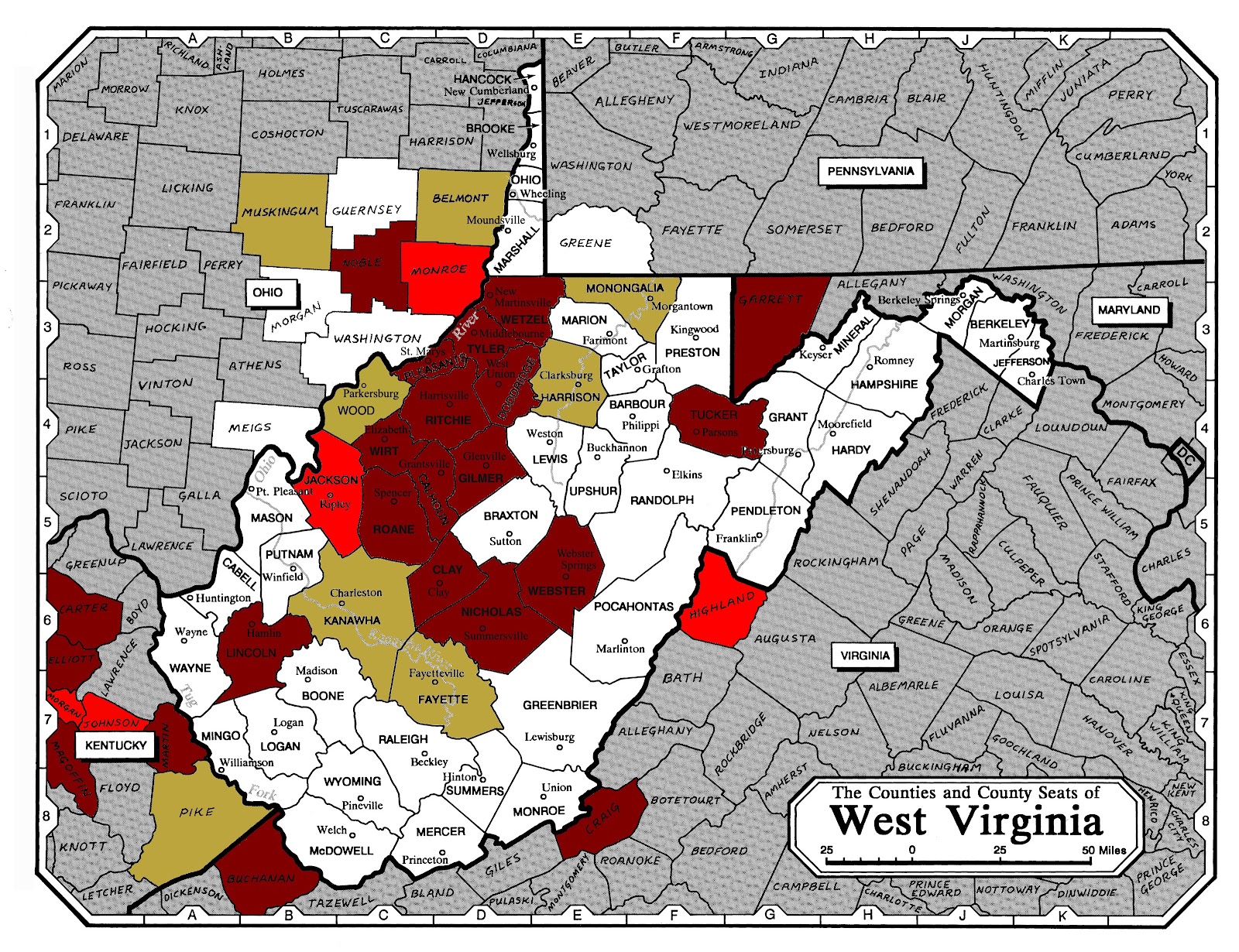
In my previous article “Sundown versus consistent GOP by county”, I noted my intention to discuss a number of counties in the northwest of West Virginia that were discussed barely or not at all by the late James Löwen in his Sundown Towns. Three of these, Ritchie County, Doddridge County, and Tyler County, I noted as among the most consistently partisan counties and as typical of fiercely Unionist counties in antebellum slave states (in effect, slave state counties without slaves).

Upon studying census data for the region surrounding these three counties, I noticed an almost continuous sundown area surrounding these three rock-ribbed Unionist GOP strongholds. The apparent sundown area extended as far east as heavily secessionist Webster County, which was only once won by a Republican before 2012, and also includes two counties in neighbouring Ohio.
Map of West Virginia and neighbouring areas with labelled counties showing the continuous sundown area around Ritchie, Tyler and Doddridge Counties. Dark red are likely or known sundown counties, red are highly possible sundown counties, and gold are counties that have had a population over 75,000 in at least one census.
County State Census
Total black population Number of black households
1880 1890 1900 1910 1920 1930 1940 1950 1960 1970 1980 1990 2000 2010
Monroe Ohio 80 102 84 90 62 37 45 21 7 2 2 3 9 19
Noble Ohio 94 37 37 44 24 28 24 9 3 1 0 4 6 4
Wetzel West Virginia 22 36 439 57 89 53 29 33 5 0 3 6 3 5
Pleasants West Virginia 26 9 6 9 7 0 0 3 8 0 8 0 2 5
Tyler West Virginia 6 2 94 115 52 35 27 20 12 1 4 0 0 1
Ritchie West Virginia 64 36 26 26 13 7 9 5 1 0 0 2 7 8
Doddridge West Virginia 54 131 25 8 1 20 5 2 1 0 0 0 0 2
Wirt West Virginia 13 24 64 40 35 25 38 20 13 0 0 2 4 4
Jackson West Virginia 103 87 115 26 12 4 1 3 6 0 5 9 8 24
Roane West Virginia 39 29 32 18 12 14 3 23 17 0 0 0 12 9
Calhoun West Virginia 74 81 83 80 36 12 7 10 12 0 0 0 1 2
Gilmer West Virginia 47 50 36 17 38 21 2 24 1 1 0 5 12 28
Clay West Virginia 0 0 18 5 147 170 201 58 66 0 0 0 1 2
Braxton West Virginia 104 134 187 221 273 188 160 111 119 22 28 29 28 27
Lewis West Virginia 323 261 178 239 291 122 93 62 95 19 17 8 8 13
Webster West Virginia 2 11 12 8 0 9 1 4 1 0 0 0 0 2
Nicholas West Virginia 58 21 19 48 68 65 24 32 6 0 4 1 2 10
Of the counties shown above, there is some discussion of Pleasants County here, but the fact that census data for surrounding counties indicates they were probably sundown is not noted. New Martinsville, the seat of Wetzel County, is also discussed here, but that Wetzel County was probably sundown throughout is never noted. It is worthwhile to note that in the 1860 census, the last before slavery was abolished, Ritchie County had no free blacks at all. The table above suggests that most of the counties in this sundown area got rid of their black populations in the 1900s, with this date being most apparent for Doddridge County, and not improbable for Wetzel, Ritchie, Roane and Jackson Counties. Some other counties — such as Calhoun and Gilmer — may have got rid of their black populations around the Depression era. (Tucker County, an isolated probable sundown county on the map, appears to have got rid of its African Americans only after Brown v. Board of Education. The same is true of Highland County, and possibly of Nicholas and Wirt).

In order to establish this as a distinct area of sundown or probably sundown counties, I have compiled census data for surrounding counties that have never had a population of 75,000 or greater in any census. (As I noted earlier, this cutoff may in fact be too large). Upshur County’s figures were already shown in the previous post, but Upshur is unlikely to have been a sundown county.
County State Census
Total black population Number of black households
1880 1890 1900 1910 1920 1930 1940 1950 1960 1970 1980 1990 2000 2010
Greene Pennsylvania 503 445 313 389 300 516 417 450 360 98 95 77 61 81
Marshall West Virginia 223 236 499 575 502 882 881 323 360 36 45 41 41 50
Guernsey Ohio 586 496 472 489 456 571 596 622 688 166 196 233 235 208
Morgan Ohio 193 160 131 147 233 275 377 361 500 122 162 209 204 184
Washington Ohio 1,243 1,412 1,597 1,378 1,165 1,185 1,143 865 843 205 299 291 244 265
Meigs Ohio 1,798 1,405 969 690 631 596 507 415 339 72 109 65 68 93
Mason West Virginia 859 759 537 349 227 692 670 755 529 58 37 32 44 45
Putnam West Virginia 355 237 378 435 397 124 145 12 13 27 18 41 99 173
Greenbrier West Virginia 1,981 1,993 1,829 1,779 1,726 2,329 2,430 2,014 1,879 483 516 508 487 445
Pocahontas West Virginia 334 353 625 445 558 638 646 628 373 56 30 30 21 12
Randolph West Virginia 112 262 519 376 431 342 391 385 260 61 51 38 41 44
Upshur West Virginia 201 256 221 226 196 201 155 92 71 19 20 29 22 27
Whilst most of these figures do suggest a definite boundary of the sundown area, it might be noted that most of Randolph County was probably sundown and may still be, although the county seat of Elkins and unincorporated parts of its associated district have always had at least thirty black households. Six of Randolph’s nine districts had no black household in 2010. Guernsey County shows a somewhat similar pattern: almost all the black households were and are in county seat Cambridge and the surrounding township. Mason County and Point Pleasant are similar though less extreme, as thirteen of 45 black households in the county lied outside its district. (That boundaries of large sundown areas do not correspond with county lines is the rule rather than the exception). Whether the apparently sundown part of Randolph became so before 1940 as the group of counties tabled above did, or with Brown v. Board as Tucker County apparently did, it is difficult to check with census data.